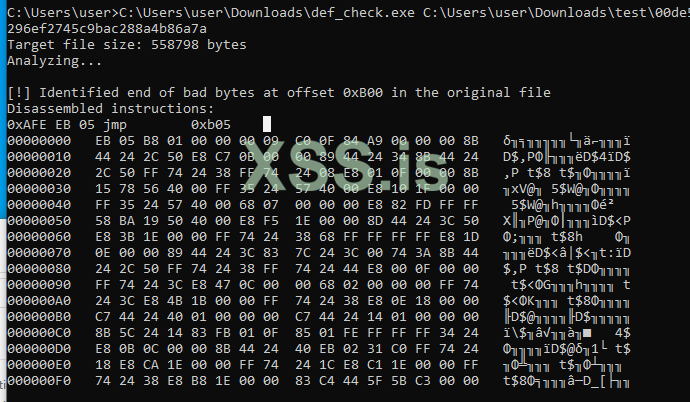
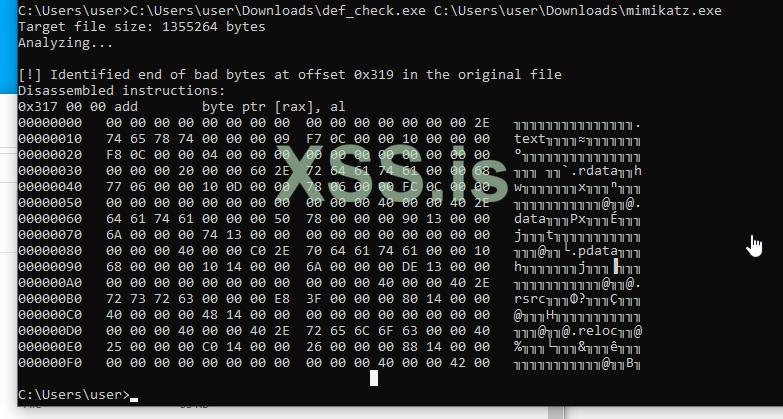
Я хотел бы поделиться с вами интересным проектом, который мог бы быть полезным для анализа сигнатур от WD. Возможно, вы уже знакомы с ним - https://github.com/matterpreter/DefenderCheck.
После некоторого времени проведенного за изучением и разработкой, я создал асинхронную версию этого проекта, и я должен признать, что она работает гораздо быстрее. Теперь можно быстро обрабатывать большие объемы данных и искать сигнатуры, которые могут указывать на проблемы с WD. Просто скопируйте сигнатуру в hex-редакторе, используя код из проекта, и вы сможете найти и исправить проблему.

Для компиляции замените код на следующий:
Надеюсь, что этот проект будет полезным для вас, и я призываю вас воспользоваться им. Если у вас есть какие-либо вопросы или отзывы, буду рад услышать их.
Удачи и продуктивного анализа сигнатур!
После некоторого времени проведенного за изучением и разработкой, я создал асинхронную версию этого проекта, и я должен признать, что она работает гораздо быстрее. Теперь можно быстро обрабатывать большие объемы данных и искать сигнатуры, которые могут указывать на проблемы с WD. Просто скопируйте сигнатуру в hex-редакторе, используя код из проекта, и вы сможете найти и исправить проблему.
Для компиляции замените код на следующий:
C#:
using System;
using System.Collections.Generic;
using System.ComponentModel;
using System.Diagnostics;
using System.IO;
using System.Text;
using System.Threading;
using System.Threading.Tasks;

namespace DefenderCheck
{
    static class ProcessExtensions
    {
        public static Task WaitForExitAsync(this Process process, CancellationToken cancellationToken = default)
        {
            if (process == null)
                throw new ArgumentNullException(nameof(process));

            var tcs = new TaskCompletionSource<bool>();

            process.EnableRaisingEvents = true;
            process.Exited += (s, e) => tcs.TrySetResult(true);
            if (cancellationToken != default)
                cancellationToken.Register(() => tcs.TrySetCanceled());

            return tcs.Task;
        }
    }

    class Program
    {
        private const string TempDirectoryPath = @"C:\Temp";
        private const string TestFilePath = @"C:\Temp\testfile.exe";

        static async Task Main(string[] args)
        {
            bool debug = false;
            if (args.Length == 2 && args[1].Contains("debug"))
            {
                debug = true;
            }

            string targetFile = args[0];
            if (!File.Exists(targetFile))
            {
                Console.WriteLine("[-] Can't access the target file");
                return;
            }

            string originalFileDetectionStatus = Scan(targetFile).ToString();
            if (originalFileDetectionStatus.Equals("NoThreatFound"))
            {
                if (debug) { Console.WriteLine("Scanning the whole file first"); }
                Console.WriteLine("[+] No threat found in the submitted file!");
                return;
            }

            if (!Directory.Exists(TempDirectoryPath))
            {
                Console.WriteLine(@"[-] C:\Temp doesn't exist. Creating it...");
                Directory.CreateDirectory(TempDirectoryPath);
            }

            byte[] originalFileContents = await ReadAllBytesAsync(targetFile);
            int originalFileSize = originalFileContents.Length;
            Console.WriteLine("Target file size: {0} bytes", originalFileContents.Length);
            Console.WriteLine("Analyzing...\n");

            byte[] buffer = new byte[originalFileSize / 2];
            Array.Copy(originalFileContents, 0, buffer, 0, buffer.Length);
            int lastGood = 0;

            bool threatFound = false;

            while (!threatFound)
            {
                if (debug) { Console.WriteLine("Testing {0} bytes", buffer.Length); }
                await WriteAllBytesAsync(TestFilePath, buffer);

                List<Task<ScanResult>> scanTasks = new List<Task<ScanResult>>
                {
                    Task.Run(() => Scan(TestFilePath))
                };
                for (int i = 0; i < lastGood; i += buffer.Length)
                {
                    int remainingBytes = originalFileContents.Length - i;
                    int bytesToCopy = Math.Min(buffer.Length, remainingBytes);
                    byte[] previousPart = new byte[bytesToCopy];
                    Array.Copy(originalFileContents, i, previousPart, 0, bytesToCopy);
                    string previousFilePath = $@"{TempDirectoryPath}\previousPart{i}.exe";
                    await WriteAllBytesAsync(previousFilePath, previousPart);
                    scanTasks.Add(Task.Run(() => Scan(previousFilePath)));
                }

                await Task.WhenAll(scanTasks);

                foreach (var task in scanTasks)
                {
                    string detectionStatus = task.Result.ToString();
                    if (detectionStatus.Equals("ThreatFound"))
                    {
                        if (debug) { Console.WriteLine("Threat found. Half-splitting again..."); }
                        byte[] tempArray = await HalfSplitterAsync(buffer, lastGood);
                        Array.Resize(ref buffer, tempArray.Length);
                        Array.Copy(tempArray, buffer, tempArray.Length);
                        break;
                    }
                    else if (detectionStatus.Equals("NoThreatFound"))
                    {
                        if (debug) { Console.WriteLine("No threat found. Going up 50% of the current size."); };
                        lastGood = buffer.Length;
                        byte[] tempArray = Overshot(originalFileContents, buffer.Length);
                        if (tempArray.Length == buffer.Length)
                        {
                            Console.WriteLine("Exhausted the search. The binary looks good to go!");
                            Environment.Exit(0);
                        }
                        Array.Resize(ref buffer, tempArray.Length);
                        Array.Copy(tempArray, buffer, tempArray.Length);
                    }
                    else
                    {
                        Console.WriteLine("Unknown detection status: {0}", detectionStatus);
                        Environment.Exit(1);
                    }
                }
            }
        }
        public static async Task<ScanResult> ScanByteArray(byte[] bytes)
        {
            // Создаем временный файл для сохранения массива байтов
            string tempFilePath = Path.Combine(TempDirectoryPath, "tempfile.exe");

            try
            {
                // Записываем массив байтов во временный файл
                await WriteAllBytesAsync(tempFilePath, bytes);

                // Выполняем сканирование временного файла
                ScanResult scanResult = await Scan(tempFilePath);

                return scanResult;
            }
            finally
            {
                // Удаляем временный файл
                if (File.Exists(tempFilePath))
                {
                    File.Delete(tempFilePath);
                }
            }
        }

        public static async Task<byte[]> HalfSplitterAsync(byte[] originalarray, int lastgood)
        {
            int startIndex = lastgood;
            int endIndex = originalarray.Length;
            int bufferSize = endIndex - startIndex;

            if (bufferSize <= 0)
            {
                Console.WriteLine("[-] Invalid buffer size. Something is wrong...");
                Environment.Exit(1);
            }

            byte[] splitarray = new byte[bufferSize];
            Array.Copy(originalarray, startIndex, splitarray, 0, bufferSize);

            // Scan the split array for threats
            ScanResult scanResult = await ScanByteArray(splitarray);
            if (scanResult == ScanResult.ThreatFound)
            {
                Console.WriteLine("[!] Identified end of bad bytes at offset 0x{0:X} in the original file", endIndex);
                await Scan(TestFilePath, true);

                byte[] offendingBytes = new byte[256];
                int offendingBytesLength = Math.Min(bufferSize, 256);
                Array.Copy(splitarray, bufferSize - offendingBytesLength, offendingBytes, 0, offendingBytesLength);

                HexDump(offendingBytes, 16);
                File.Delete(TestFilePath);
                Environment.Exit(0);
            }

            return splitarray;
        }


        public static byte[] Overshot(byte[] originalArray, int splitArraySize)
        {
            int newSize = splitArraySize + (originalArray.Length - splitArraySize) / 2;
            if (newSize == originalArray.Length - 1)
            {
                Console.WriteLine("Exhausted the search. The binary looks good to go!");
                Environment.Exit(0);
            }

            byte[] newArray = new byte[newSize];
            Array.Copy(originalArray, 0, newArray, 0, newArray.Length);
            return newArray;
        }

        public static async Task<byte[]> ReadAllBytesAsync(string path)
        {
            using (FileStream sourceStream = new FileStream(path,
                FileMode.Open, FileAccess.Read, FileShare.Read,
                bufferSize: 4096, useAsync: true))
            {
                int bufferSize = (int)sourceStream.Length;
                byte[] buffer = new byte[bufferSize];
                await sourceStream.ReadAsync(buffer, 0, bufferSize);
                return buffer;
            }
        }

        public static async Task WriteAllBytesAsync(string path, byte[] bytes)
        {
            using (FileStream destinationStream = new FileStream(path,
                FileMode.Create, FileAccess.Write, FileShare.None,
                bufferSize: 4096, useAsync: true))
            {
                await destinationStream.WriteAsync(bytes, 0, bytes.Length);
            }
        }

        public static async Task<ScanResult> Scan(string file, bool getSig = false)
        {
            if (!File.Exists(file))
            {
                return ScanResult.FileNotFound;
            }

            var process = new Process();
            var mpcmdrun = new ProcessStartInfo(@"C:\Program Files\Windows Defender\MpCmdRun.exe")
            {
                Arguments = $"-Scan -ScanType 3 -File \"{file}\" -DisableRemediation -Trace -Level 0x10",
                CreateNoWindow = true,
                ErrorDialog = false,
                UseShellExecute = false,
                RedirectStandardOutput = true,
                WindowStyle = ProcessWindowStyle.Hidden
            };

            process.StartInfo = mpcmdrun;
            process.Start();
            await process.WaitForExitAsync(); // Ожидание асинхронного завершения процесса

            if (!process.HasExited)
            {
                process.Kill();
                return ScanResult.Timeout;
            }

            if (getSig)
            {
                string stdout;
                while ((stdout = await process.StandardOutput.ReadLineAsync()) != null)
                {
                    if (stdout.Contains("Threat  "))
                    {
                        string[] sig = stdout.Split(' ');
                        string sigName = sig[19];
                        Console.WriteLine($"File matched signature: \"{sigName}\"\n");
                        break;
                    }
                }
            }

            switch (process.ExitCode)
            {
                case 0:
                    return ScanResult.NoThreatFound;
                case 2:
                    return ScanResult.ThreatFound;
                default:
                    return ScanResult.Error;
            }
        }

        public enum ScanResult
        {
            [Description("No threat found")]
            NoThreatFound,
            [Description("Threat found")]
            ThreatFound,
            [Description("The file could not be found")]
            FileNotFound,
            [Description("Timeout")]
            Timeout,
            [Description("Error")]
            Error
        }

        //Adapted from https://www.codeproject.com/Articles/36747/Quick-and-Dirty-HexDump-of-a-Byte-Array
        public static void HexDump(byte[] bytes, int bytesPerLine = 16)
        {
            if (bytes == null)
            {
                Console.WriteLine("[-] Empty array supplied. Something is wrong...");
                return;
            }

            int bytesLength = bytes.Length;
            int totalLines = (bytesLength + bytesPerLine - 1) / bytesPerLine;
            StringBuilder result = new StringBuilder();

            for (int line = 0; line < totalLines; line++)
            {
                int lineStart = line * bytesPerLine;
                int lineEnd = Math.Min(lineStart + bytesPerLine, bytesLength);
                int lineLength = lineEnd - lineStart;

                // Hex representation
                StringBuilder hexBuilder = new StringBuilder(lineLength * 3);
                for (int i = lineStart; i < lineEnd; i++)
                {
                    hexBuilder.Append(bytes[i].ToString("X2"));
                    hexBuilder.Append(" ");
                }
                string hexLine = hexBuilder.ToString().PadRight(bytesPerLine * 3);

                // ASCII representation
                StringBuilder asciiBuilder = new StringBuilder(lineLength);
                for (int i = lineStart; i < lineEnd; i++)
                {
                    byte b = bytes[i];
                    char c = (b >= 32 && b <= 126) ? (char)b : '.';
                    asciiBuilder.Append(c);
                }
                string asciiLine = asciiBuilder.ToString();

                // Combine hex and ASCII lines
                string fullLine = $"{hexLine}  {asciiLine}\n";
                result.Append(fullLine);
            }

            Console.WriteLine(result.ToString());
        }

    }
}
Надеюсь, что этот проект будет полезным для вас, и я призываю вас воспользоваться им. Если у вас есть какие-либо вопросы или отзывы, буду рад услышать их.
Удачи и продуктивного анализа сигнатур!