

about a week now, i was wondering how does " pointer scanning " work exactly, it's not that type of question of how to use it in cheat engine or something, but how in the code work, I spend some time for this week to learn how virtual memory work, some known win32 api functions too, i asked the developer of cheat engine:
borya — 27/02/2025 01:31
is it like tryin to get all pointers and derefrencing them?
DB — 27/02/2025 01:31
kinda yes, but then the opposite way. It finds all the pointers that reference the specific address, and then goes back to those pointers and repeats
borya — 27/02/2025 01:32
what
how this is even possible
DB — 27/02/2025 01:33
A pointer is just a 4/8 byte value representing a memory address. If you have a memory address you can scan for a value between that value and that value minus the maximum offset you wish to check for
borya — 28/02/2025 01:43
isn't like starting from base adress + some random memory then derefrence until you find a value will be easier?
how can you start from the target adress until the base adress?
DB — 28/02/2025 18:47
see it like raytracing. Instead of going from a lightsource following every possible path until a screen pixel is hit, go from a screenpixel and follow the paths until a lightsource is detected
Same for pointerscan. You can start from a static address but the chance you start with a base address that eventually leads to your destination is astronomically small. And it will take a lot of pathfollowing to figure that out
If you start with the destination then at least all the paths inspected have at least something to do with the destination.
does anyone have any idea what did he mean? i searched a little bit and got an idea
that we need to read all the Virtual memory of that process, well the stack and the heap, so we need something like
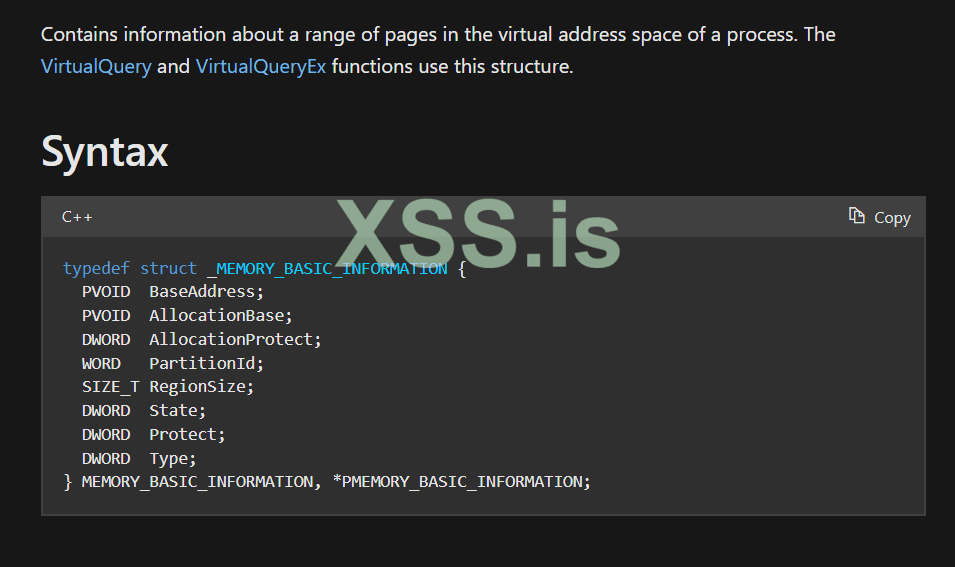
so we need like to check after using something like:
i don't know too much about windows, it's been like a week only or maybee two, the main thing i find is that this process of "pointer scaning " has a big relation with PEB,TEB and the kernel struct of KUSER_SHARED_DATA.
anyone understand the point I'm trying to get, please give any advice or any possible information, i know cheat engine is open source, but i don't know how to read such big projects... a lot of dirs and files with each one has over 2k line....I'm not on that level yet, pretty sure shrekushka ,varwar , DildoFagins would say something, I searched a lot, but nothing that explain that process..
thank you all))
borya — 27/02/2025 01:31
is it like tryin to get all pointers and derefrencing them?
DB — 27/02/2025 01:31
kinda yes, but then the opposite way. It finds all the pointers that reference the specific address, and then goes back to those pointers and repeats
borya — 27/02/2025 01:32
what
how this is even possible
DB — 27/02/2025 01:33
A pointer is just a 4/8 byte value representing a memory address. If you have a memory address you can scan for a value between that value and that value minus the maximum offset you wish to check for
borya — 28/02/2025 01:43
isn't like starting from base adress + some random memory then derefrence until you find a value will be easier?
how can you start from the target adress until the base adress?
DB — 28/02/2025 18:47
see it like raytracing. Instead of going from a lightsource following every possible path until a screen pixel is hit, go from a screenpixel and follow the paths until a lightsource is detected
Same for pointerscan. You can start from a static address but the chance you start with a base address that eventually leads to your destination is astronomically small. And it will take a lot of pathfollowing to figure that out
If you start with the destination then at least all the paths inspected have at least something to do with the destination.
does anyone have any idea what did he mean? i searched a little bit and got an idea
that we need to read all the Virtual memory of that process, well the stack and the heap, so we need something like
VirtualQueryEx since it fills the MEMORY_BASIC_INFORMATION struct that has can we check through, what region or section we are in :
so we need like to check after using something like:
C++:
MEMORY_BASIC_INFORMATION mbinfo;
memset(&mbi, 0, sizeof(mbinfo));
/*
// then calling her VirtualQueryEx
*/

// now checking if that pages are commited and have permission at least READ_WRITE
if ((mbinfo.state == MEM_COMMIT) && (mbinfo.Protect & PAGE_READWRITE) ){
    //do something
}
i don't know too much about windows, it's been like a week only or maybee two, the main thing i find is that this process of "pointer scaning " has a big relation with PEB,TEB and the kernel struct of KUSER_SHARED_DATA.
C++:
typedef struct _KUSER_SHARED_DATA {
  ULONG                         TickCountLowDeprecated;
  ULONG                         TickCountMultiplier;
  KSYSTEM_TIME                  InterruptTime;
  KSYSTEM_TIME                  SystemTime;
  KSYSTEM_TIME                  TimeZoneBias;
  USHORT                        ImageNumberLow;
  USHORT                        ImageNumberHigh;
  WCHAR                         NtSystemRoot[260];
  ULONG                         MaxStackTraceDepth;
  ULONG                         CryptoExponent;
  ULONG                         TimeZoneId;
  ULONG                         LargePageMinimum;
  ULONG                         AitSamplingValue;
  ULONG                         AppCompatFlag;
  ULONGLONG                     RNGSeedVersion;
  ULONG                         GlobalValidationRunlevel;
  LONG                          TimeZoneBiasStamp;
  ULONG                         NtBuildNumber;
  NT_PRODUCT_TYPE               NtProductType;
  BOOLEAN                       ProductTypeIsValid;
  BOOLEAN                       Reserved0[1];
  USHORT                        NativeProcessorArchitecture;
  ULONG                         NtMajorVersion;
  ULONG                         NtMinorVersion;
  BOOLEAN                       ProcessorFeatures[PROCESSOR_FEATURE_MAX];
  ULONG                         Reserved1;
  ULONG                         Reserved3;
  ULONG                         TimeSlip;
  ALTERNATIVE_ARCHITECTURE_TYPE AlternativeArchitecture;
  ULONG                         BootId;
  LARGE_INTEGER                 SystemExpirationDate;
  ULONG                         SuiteMask;
  BOOLEAN                       KdDebuggerEnabled;
  union {
    UCHAR MitigationPolicies;
    struct {
      UCHAR NXSupportPolicy : 2;
      UCHAR SEHValidationPolicy : 2;
      UCHAR CurDirDevicesSkippedForDlls : 2;
      UCHAR Reserved : 2;
    };
  };
  USHORT                        CyclesPerYield;
  ULONG                         ActiveConsoleId;
  ULONG                         DismountCount;
  ULONG                         ComPlusPackage;
  ULONG                         LastSystemRITEventTickCount;
  ULONG                         NumberOfPhysicalPages;
  BOOLEAN                       SafeBootMode;
  union {
    UCHAR VirtualizationFlags;
    struct {
      UCHAR ArchStartedInEl2 : 1;
      UCHAR QcSlIsSupported : 1;
    };
  };
  UCHAR                         Reserved12[2];
  union {
    ULONG SharedDataFlags;
    struct {
      ULONG DbgErrorPortPresent : 1;
      ULONG DbgElevationEnabled : 1;
      ULONG DbgVirtEnabled : 1;
      ULONG DbgInstallerDetectEnabled : 1;
      ULONG DbgLkgEnabled : 1;
      ULONG DbgDynProcessorEnabled : 1;
      ULONG DbgConsoleBrokerEnabled : 1;
      ULONG DbgSecureBootEnabled : 1;
      ULONG DbgMultiSessionSku : 1;
      ULONG DbgMultiUsersInSessionSku : 1;
      ULONG DbgStateSeparationEnabled : 1;
      ULONG SpareBits : 21;
    } DUMMYSTRUCTNAME2;
  } DUMMYUNIONNAME2;
  ULONG                         DataFlagsPad[1];
  ULONGLONG                     TestRetInstruction;
  LONGLONG                      QpcFrequency;
  ULONG                         SystemCall;
  ULONG                         Reserved2;
  ULONGLONG                     FullNumberOfPhysicalPages;
  ULONGLONG                     SystemCallPad[1];
  union {
    KSYSTEM_TIME TickCount;
    ULONG64      TickCountQuad;
    struct {
      ULONG ReservedTickCountOverlay[3];
      ULONG TickCountPad[1];
    } DUMMYSTRUCTNAME;
  } DUMMYUNIONNAME3;
  ULONG                         Cookie;
  ULONG                         CookiePad[1];
  LONGLONG                      ConsoleSessionForegroundProcessId;
  ULONGLONG                     TimeUpdateLock;
  ULONGLONG                     BaselineSystemTimeQpc;
  ULONGLONG                     BaselineInterruptTimeQpc;
  ULONGLONG                     QpcSystemTimeIncrement;
  ULONGLONG                     QpcInterruptTimeIncrement;
  UCHAR                         QpcSystemTimeIncrementShift;
  UCHAR                         QpcInterruptTimeIncrementShift;
  USHORT                        UnparkedProcessorCount;
  ULONG                         EnclaveFeatureMask[4];
  ULONG                         TelemetryCoverageRound;
  USHORT                        UserModeGlobalLogger[16];
  ULONG                         ImageFileExecutionOptions;
  ULONG                         LangGenerationCount;
  ULONGLONG                     Reserved4;
  ULONGLONG                     InterruptTimeBias;
  ULONGLONG                     QpcBias;
  ULONG                         ActiveProcessorCount;
  UCHAR                         ActiveGroupCount;
  UCHAR                         Reserved9;
  union {
    USHORT QpcData;
    struct {
      UCHAR QpcBypassEnabled;
      UCHAR QpcReserved;
    };
  };
  LARGE_INTEGER                 TimeZoneBiasEffectiveStart;
  LARGE_INTEGER                 TimeZoneBiasEffectiveEnd;
  XSTATE_CONFIGURATION          XState;
  KSYSTEM_TIME                  FeatureConfigurationChangeStamp;
  ULONG                         Spare;
  ULONG64                       UserPointerAuthMask;
  XSTATE_CONFIGURATION          XStateArm64;
  ULONG                         Reserved10[210];
} KUSER_SHARED_DATA, *PKUSER_SHARED_DATA;
anyone understand the point I'm trying to get, please give any advice or any possible information, i know cheat engine is open source, but i don't know how to read such big projects... a lot of dirs and files with each one has over 2k line....I'm not on that level yet, pretty sure shrekushka ,varwar , DildoFagins would say something, I searched a lot, but nothing that explain that process..
thank you all))

