Before start, we establish few things -->
1. Strength merely because of repeated application of transformation passes, nesting, combinations is mostly bad + technically speaks low of the obfuscator author.
2. I will not speak for MorphMePlease nor am I affiliated with Octavian in any way. The project is interesting but benchmarks are somewhat vague in terms of mathematical metrics, strength against cfg, MBA deobfuscation, symbolic execution attacks, but I am impressed by his technical feat of successfully working at the AST level (especially for modern syntaxes of C/C++) instead of opting for something at a lower level intermediate level (for me, it is convenient to work with SSA style well formed IR than with trees), and also respect the author on his contributions to the forum with his interesting research. I will not speak against or make assumptions about MMP in any way, since there's no public knowledge about it's obfuscation capabilities. I did not provide the basic definitions of what an opaque predicate or MBA is for example. I encourage buyers to read the MMP sale page + google for the understanding of existing obfuscation techniques and practically test the capabilities of existing obfuscators first.
[1] OLLVM github.com/obfuscator-llvm/obfuscator
[2] Hikari github.com/HikariObfuscator/Core
[3] Pluto github.com/bluesadi/Pluto-Obfuscator
[4] YANSO github.com/emc2314/YANSOllvm
[5] GDop https://faculty.ist.psu.edu/wu/papers/opaque-isc16.pdf github.com/s3team/gdop/
[6] github.com/quarkslab/llvm-passes, github.com/Deniskore/llvm
[7] Tigress tigress.wtf/transformations/
[8] *MorphMePlease /threads/73254/
[9] Armariris github.com/GoSSIP-SJTU/Armariris
[10] IOLLVM arxiv.org/abs/2203.03169
[11] Automatic generation of opaque constants based on the k-clique problem for resilient data obfuscation https://ieeexplore.ieee.org/document/7884620
Experimental assessment of XOR-Masking data obfuscation based on K-Clique opaque constants https://www.sciencedirect.com/science/article/abs/pii/S0164121219302663
[12] loop: Logic-Oriented Opaque Predicate Detection in Obfuscated Binary Code https://dl.acm.org/doi/10.1145/2810103.2813617 github.com/s3team/loop
[13] blog.quarkslab.com/deobfuscation-recovering-an-ollvm-protected-program/
[14] hex-rays.com/blog/hex-rays-microcode-api-vs-obfuscating-compiler/
[15] eshard.com/posts/D810-a-journey-into-control-flow-unflattening/
[16] govcert.ch/whitepapers/unflattening-confuserex-code-in-ida/
[17] MBA-Blast usenix.org/conference/usenixsecurity21/presentation/liu-binbin
https://github.com/softsec-unh/MBA-Blast
[18] https://news.sophos.com/en-us/2022/05/04/attacking-emotets-control-flow-flattening/
[19] https://www.politoinc.com/post/2020...ation-of-windows-malwareexploits-using-o-llvm
The name is somewhat a clickbait (steal of spotlight) for potential customers from the original OLLVM.
But I was hesitant to build it under the name of OLLVM++ because of an interesting reason, most people don't know that the OLLVM when it was released, all of it's techniques were easily deobfuscatable at that time, this applies similarly to Pluto, Hikari (open + closed source, commercial Hikari isn't strong as you think). The only places where Hikari commercial version shines brighter than OLLVM++ is in stronger implementation for some runtime to not break in rare nuanced, bespoke scenarios, but OLLVM++ is strong in this area as well and will get better over time.
The OLLVM++ at the time of release, the core obfuscation logic cannot be attacked because of the current limits of the deobfuscation techniques, both widely used and experimental in research stages. Moreover the practical tools in cybersecurity are always many steps behind from what is already scientifically researched.
--> Technically, every language that compiles to LLVM IR is supported. There's nothing major at the LLVM IR that breaks based on the choice frontend language, operating system, architecture.
C/C++, ObjC (clang), swift, rust (rustc), zig etc, x86, x86-64, arm etc (semantic morphing in control flow, some of the call graphs passes, MBAs, generally don't result in breaking on other arch like MIPS but there's no valid testing from my side)
In my opinion, all the existing code obfuscation techniques (non adversarial) -->
1. Data
2. Control Flow Graph (CFG) (intra function)
3. Call Graph (inter function)
Data
---
OLLVM: doesn't provide.
Hikari: String (globals) Encryption (XOR mask + decrypt under a global ctor)
Pluto: MBA
YANSO: ObfCon
GDop: not concerned
*MorphMePlease: 1. Constant Folding (MBA), 4. String encryption, 8. Legitimate strings generator, 12. Expression morphing
Armariris: doesn't provide
IOLLVM: doesn't provide
K-Clique paper [11] --> Ideally this is perfect, using NP problems that evaluate in the process of XOR masking, in essence, hard 3SAT construction based on the old paper Bart Selman --> to k clique using karp reduction --> breaking == solving np problem. Our technique can be considered an NP problem, because there's no quick way to solve the MBA in polynomial time, the given solution can be verified in polynomial time (at runtime). But the technique proposed (final math expressions) in the paper has 100x overhead compared to our technique with math expressions.
parameters to evaluate the quality of MBA -->
1. Strength: Can it be deobfuscated by state of the art MBA solvers like MBA-Blast, USENIX? If it can be simplified, under what time?
2. Runtime Overhead: essentially the compute required which is FLOP count of the expression
All of these MBA are simplified instantly by MBA solvers. A new technique was developed using algebraic geometry, special functions, secrets... that generates MBAs that cannot be solved by state of the art MBA-Solvers and also have low FLOP count.
For example, none of the techniques available can be extended from 2 variable formulae to n variables. This can be done with Pluto's truth table technique but exponentially increases with n, 3 variables itself becomes impossibly computationally heavy obfuscating a simple program.
Control Flow Graph
---
Flattening
---
This is the least interesting and even worse transformation (due to overhead) on this list provides and most authors market their obfuscators with no modifications to little modifications (like nested switching, bogus blocks).
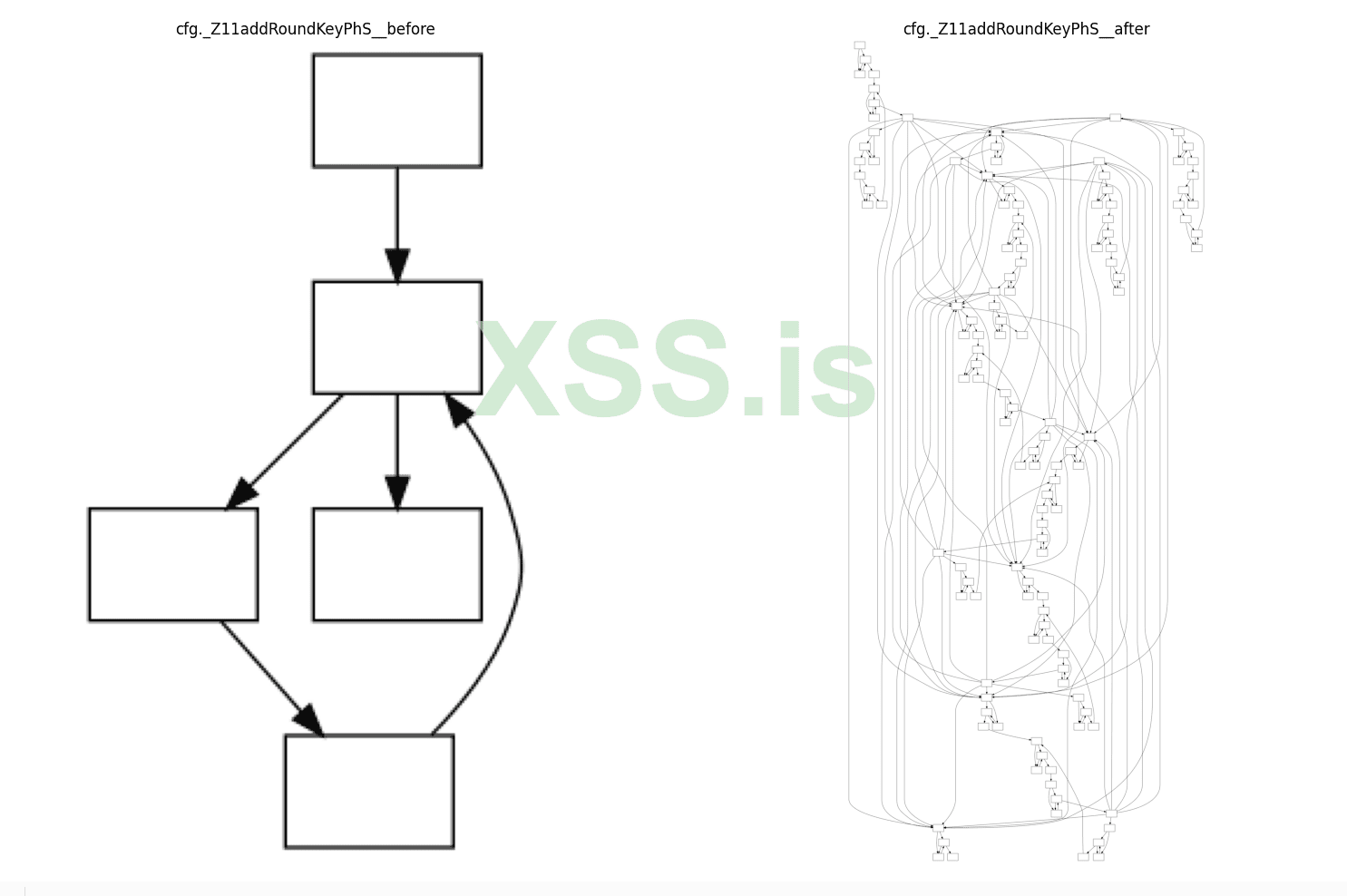
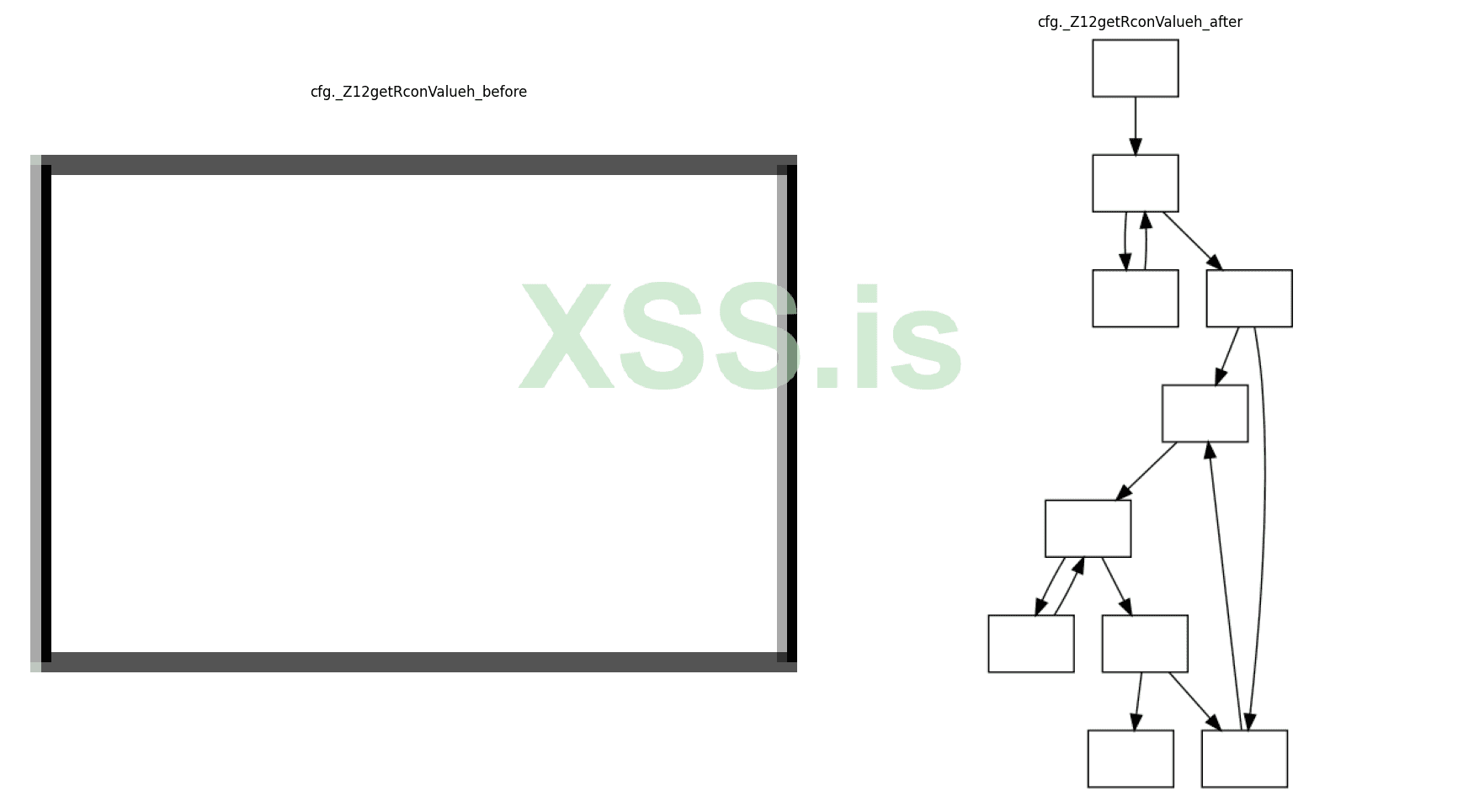
I made my own variant of this transform (not nesting, bogus blocks, nothing so far I could find either in the public research) which puts radical complexity in the control flow graph, if you believe in cyclomatic complexity as a metric for this, then it's 10 times stronger than OLLVM, without giving away the graph structures (which vary every transformation) here, buyers will get the detailed walkthrough with graphs, cyclomatic complexity before and after, and most importantly how it's different from OLLVM, IOLLVM etc.
If overhead is not a factor, then I encourage the application of flattening.
All of the existing flattening and their variants with slight modifications have many well documented deobfuscation techniques. I propose a stronger variant that significantly increases cyclomatic complexity, bypasses all deobfuscation techniques and behaves somewhat differently in terms of graph structure compared to existing techniques.
Opaque Predicates
---
The strongest adversary of opaque predicates is symbolic execution. Symbolic execution was incredibly stronger at the time OLLVM, Pluto were released and all of them would've been solved then. Now it has gotten even stronger and by the far the most mature, strong engine is Angr. All the benchmarks in this page are predominantly done with Angr. Soon I will try to upload benchmarks with KLEE, BAP, Triton (if necessary, not familiar fully with some of the API) but I believe that experts who worked with symbolic engines can agree that Angr is the ultimate test.
OLLVM: BogusControlFlow (y < 10 || x * (x + 1) % 2 == 0)
Hikari: BogusControlFlow, IndirectBranch, SplitBasicBlocks
Pluto: BogusControlFlow (y < 10 || x * (x + 1) % 2 == 0) + TrapAngr (n - 3 * ((n * (uint64_t)0xAAAAAAAB) >> 33)) + RandomControlFlow (x = (x - 1) * (x + 3) - (x + 4) * (x - 3) - 9) (x = x * (x + 1) - x^2) (x = 3 * x * (x - 2) - 3 * x^2 + 7 * x)
YANSO: Connect
GDop: First time, actually made good progress with introduction of "dynamic" opaque predicates but can be executed symbolically today
*MorphMePlease: 2. Basic block opaque predicates morphing, 3. Symbolic execution protection, 5. Smart trash-code generation
Armariris: doesn't provide
IOLLVM: In-Degree obfuscation
All of these "magic numbers" type of conditions are simplified instantly by symbolic execution attacks, with MBA solvers. I propose the generation of minimal (not low) FLOP count opaque predicates that are delay symbolic execution attacks significantly, each insertion taking more taking anywhere from instant solving to n seconds calculated based from statistical analysis (can be configured, many templates to limit formation of signatures) + the cfgs are fucked anyway
Call Graph
---
OLLVM: SplitBasicBlocks, Substitution
Hikari: FunctionCallObfuscate, FunctionWrapper, Substitution
Pluto: Instruction Substitution (similar to OLLVM Substitution)
YANSO: Merge, BB2func, ObfCall, VM (similar to OLLVM Substitution)
GDop: not concerned
*MorphMePlease: 6. Executable fake functions generation, 7. Function calls obfuscation (chaining calls), 10. Spaghetti basic block morphing (control flow morphing), 11. Operations function replacement, 14. Function args obfuscation
Armariris: doesn't provide
IOLLVM: doesn't provide
There's no proper benchmark/metric for this. BinDiff? DeepBinDiff? These are the usual. But I propose similar techniques with few extra techniques of my own taking inspiration from combinatorics, graph theory to mathematically confuse reversing.
---
Ideally I am looking for a team for work on % basis --> i will listen to every proposal in PM --> the tool has to be finetuned+tested to ensure comfortable overhead+obfuscation balance --> check for breakage at runtime+finish touches+fixes blah blah --> to your specifics by manual testing
everything will be easier if --> a team who understands what code obfuscation is --> how he is different from crypters, morphing etc --> understands deobfuscation, benchmarks (provided in private) --> where it is not suitable in areas like payload delivery with file size limits --> experience with other obfuscators --> can have a technical discussion about obfuscation (without using such words --> "so it's a crypter?", "how many detects?", "sophos bypassed?")
we will sit through testing different settings depending on cases --> for example if speed is important --> i need team with little patience to optimize for best config with me --> everything is 'perf' on AES++
(researchers, avers, cops, sniffers, scammers, brian crabs, drug addicts --> throw away)
Price --> $4k
(The obfuscation logic is ready, but all the pieces of joining, clean CLI, exposing configs, transforms pipeline, final cleanups, blah blah graphic designing, oil painting, stickers (front end) is not finished, everything has to be processed together manually by me each step individually)
I plan on working on this project to further improve this, I have a list of fixes, bugs, notes, todos. More techniques have been researched but some nuances, todos, testing remains. Based on the interest of the team, I will consider this.
The project will not include source.
XSS Auto-guarant
Distribution of product, obfuscated binaries to others as a service is restricted.
I am not on any public XMPP, TOX, telegram. First contact in PM.
I am frequently away from the forum --> customers will be given a private XMPP/TOX for proper support
Donot encrypt correspondences if you throw away the keys.
1. Strength merely because of repeated application of transformation passes, nesting, combinations is mostly bad + technically speaks low of the obfuscator author.
2. I will not speak for MorphMePlease nor am I affiliated with Octavian in any way. The project is interesting but benchmarks are somewhat vague in terms of mathematical metrics, strength against cfg, MBA deobfuscation, symbolic execution attacks, but I am impressed by his technical feat of successfully working at the AST level (especially for modern syntaxes of C/C++) instead of opting for something at a lower level intermediate level (for me, it is convenient to work with SSA style well formed IR than with trees), and also respect the author on his contributions to the forum with his interesting research. I will not speak against or make assumptions about MMP in any way, since there's no public knowledge about it's obfuscation capabilities. I did not provide the basic definitions of what an opaque predicate or MBA is for example. I encourage buyers to read the MMP sale page + google for the understanding of existing obfuscation techniques and practically test the capabilities of existing obfuscators first.
[1] OLLVM github.com/obfuscator-llvm/obfuscator
[2] Hikari github.com/HikariObfuscator/Core
[3] Pluto github.com/bluesadi/Pluto-Obfuscator
[4] YANSO github.com/emc2314/YANSOllvm
[5] GDop https://faculty.ist.psu.edu/wu/papers/opaque-isc16.pdf github.com/s3team/gdop/
[6] github.com/quarkslab/llvm-passes, github.com/Deniskore/llvm
[7] Tigress tigress.wtf/transformations/
[8] *MorphMePlease /threads/73254/
[9] Armariris github.com/GoSSIP-SJTU/Armariris
[10] IOLLVM arxiv.org/abs/2203.03169
[11] Automatic generation of opaque constants based on the k-clique problem for resilient data obfuscation https://ieeexplore.ieee.org/document/7884620
Experimental assessment of XOR-Masking data obfuscation based on K-Clique opaque constants https://www.sciencedirect.com/science/article/abs/pii/S0164121219302663
[12] loop: Logic-Oriented Opaque Predicate Detection in Obfuscated Binary Code https://dl.acm.org/doi/10.1145/2810103.2813617 github.com/s3team/loop
[13] blog.quarkslab.com/deobfuscation-recovering-an-ollvm-protected-program/
[14] hex-rays.com/blog/hex-rays-microcode-api-vs-obfuscating-compiler/
[15] eshard.com/posts/D810-a-journey-into-control-flow-unflattening/
[16] govcert.ch/whitepapers/unflattening-confuserex-code-in-ida/
[17] MBA-Blast usenix.org/conference/usenixsecurity21/presentation/liu-binbin
https://github.com/softsec-unh/MBA-Blast
[18] https://news.sophos.com/en-us/2022/05/04/attacking-emotets-control-flow-flattening/
[19] https://www.politoinc.com/post/2020...ation-of-windows-malwareexploits-using-o-llvm
The name is somewhat a clickbait (steal of spotlight) for potential customers from the original OLLVM.
But I was hesitant to build it under the name of OLLVM++ because of an interesting reason, most people don't know that the OLLVM when it was released, all of it's techniques were easily deobfuscatable at that time, this applies similarly to Pluto, Hikari (open + closed source, commercial Hikari isn't strong as you think). The only places where Hikari commercial version shines brighter than OLLVM++ is in stronger implementation for some runtime to not break in rare nuanced, bespoke scenarios, but OLLVM++ is strong in this area as well and will get better over time.
The OLLVM++ at the time of release, the core obfuscation logic cannot be attacked because of the current limits of the deobfuscation techniques, both widely used and experimental in research stages. Moreover the practical tools in cybersecurity are always many steps behind from what is already scientifically researched.
--> Technically, every language that compiles to LLVM IR is supported. There's nothing major at the LLVM IR that breaks based on the choice frontend language, operating system, architecture.
C/C++, ObjC (clang), swift, rust (rustc), zig etc, x86, x86-64, arm etc (semantic morphing in control flow, some of the call graphs passes, MBAs, generally don't result in breaking on other arch like MIPS but there's no valid testing from my side)
In my opinion, all the existing code obfuscation techniques (non adversarial) -->
1. Data
2. Control Flow Graph (CFG) (intra function)
3. Call Graph (inter function)
Data
---
OLLVM: doesn't provide.
Hikari: String (globals) Encryption (XOR mask + decrypt under a global ctor)
Pluto: MBA
YANSO: ObfCon
GDop: not concerned
*MorphMePlease: 1. Constant Folding (MBA), 4. String encryption, 8. Legitimate strings generator, 12. Expression morphing
Armariris: doesn't provide
IOLLVM: doesn't provide
K-Clique paper [11] --> Ideally this is perfect, using NP problems that evaluate in the process of XOR masking, in essence, hard 3SAT construction based on the old paper Bart Selman --> to k clique using karp reduction --> breaking == solving np problem. Our technique can be considered an NP problem, because there's no quick way to solve the MBA in polynomial time, the given solution can be verified in polynomial time (at runtime). But the technique proposed (final math expressions) in the paper has 100x overhead compared to our technique with math expressions.
parameters to evaluate the quality of MBA -->
1. Strength: Can it be deobfuscated by state of the art MBA solvers like MBA-Blast, USENIX? If it can be simplified, under what time?
2. Runtime Overhead: essentially the compute required which is FLOP count of the expression
All of these MBA are simplified instantly by MBA solvers. A new technique was developed using algebraic geometry, special functions, secrets... that generates MBAs that cannot be solved by state of the art MBA-Solvers and also have low FLOP count.
For example, none of the techniques available can be extended from 2 variable formulae to n variables. This can be done with Pluto's truth table technique but exponentially increases with n, 3 variables itself becomes impossibly computationally heavy obfuscating a simple program.
Control Flow Graph
---
Flattening
---
This is the least interesting and even worse transformation (due to overhead) on this list provides and most authors market their obfuscators with no modifications to little modifications (like nested switching, bogus blocks).
I made my own variant of this transform (not nesting, bogus blocks, nothing so far I could find either in the public research) which puts radical complexity in the control flow graph, if you believe in cyclomatic complexity as a metric for this, then it's 10 times stronger than OLLVM, without giving away the graph structures (which vary every transformation) here, buyers will get the detailed walkthrough with graphs, cyclomatic complexity before and after, and most importantly how it's different from OLLVM, IOLLVM etc.
If overhead is not a factor, then I encourage the application of flattening.
All of the existing flattening and their variants with slight modifications have many well documented deobfuscation techniques. I propose a stronger variant that significantly increases cyclomatic complexity, bypasses all deobfuscation techniques and behaves somewhat differently in terms of graph structure compared to existing techniques.
Opaque Predicates
---
The strongest adversary of opaque predicates is symbolic execution. Symbolic execution was incredibly stronger at the time OLLVM, Pluto were released and all of them would've been solved then. Now it has gotten even stronger and by the far the most mature, strong engine is Angr. All the benchmarks in this page are predominantly done with Angr. Soon I will try to upload benchmarks with KLEE, BAP, Triton (if necessary, not familiar fully with some of the API) but I believe that experts who worked with symbolic engines can agree that Angr is the ultimate test.
OLLVM: BogusControlFlow (y < 10 || x * (x + 1) % 2 == 0)
Hikari: BogusControlFlow, IndirectBranch, SplitBasicBlocks
Pluto: BogusControlFlow (y < 10 || x * (x + 1) % 2 == 0) + TrapAngr (n - 3 * ((n * (uint64_t)0xAAAAAAAB) >> 33)) + RandomControlFlow (x = (x - 1) * (x + 3) - (x + 4) * (x - 3) - 9) (x = x * (x + 1) - x^2) (x = 3 * x * (x - 2) - 3 * x^2 + 7 * x)
YANSO: Connect
GDop: First time, actually made good progress with introduction of "dynamic" opaque predicates but can be executed symbolically today
*MorphMePlease: 2. Basic block opaque predicates morphing, 3. Symbolic execution protection, 5. Smart trash-code generation
Armariris: doesn't provide
IOLLVM: In-Degree obfuscation
All of these "magic numbers" type of conditions are simplified instantly by symbolic execution attacks, with MBA solvers. I propose the generation of minimal (not low) FLOP count opaque predicates that are delay symbolic execution attacks significantly, each insertion taking more taking anywhere from instant solving to n seconds calculated based from statistical analysis (can be configured, many templates to limit formation of signatures) + the cfgs are fucked anyway
Call Graph
---
OLLVM: SplitBasicBlocks, Substitution
Hikari: FunctionCallObfuscate, FunctionWrapper, Substitution
Pluto: Instruction Substitution (similar to OLLVM Substitution)
YANSO: Merge, BB2func, ObfCall, VM (similar to OLLVM Substitution)
GDop: not concerned
*MorphMePlease: 6. Executable fake functions generation, 7. Function calls obfuscation (chaining calls), 10. Spaghetti basic block morphing (control flow morphing), 11. Operations function replacement, 14. Function args obfuscation
Armariris: doesn't provide
IOLLVM: doesn't provide
There's no proper benchmark/metric for this. BinDiff? DeepBinDiff? These are the usual. But I propose similar techniques with few extra techniques of my own taking inspiration from combinatorics, graph theory to mathematically confuse reversing.
---
Ideally I am looking for a team for work on % basis --> i will listen to every proposal in PM --> the tool has to be finetuned+tested to ensure comfortable overhead+obfuscation balance --> check for breakage at runtime+finish touches+fixes blah blah --> to your specifics by manual testing
everything will be easier if --> a team who understands what code obfuscation is --> how he is different from crypters, morphing etc --> understands deobfuscation, benchmarks (provided in private) --> where it is not suitable in areas like payload delivery with file size limits --> experience with other obfuscators --> can have a technical discussion about obfuscation (without using such words --> "so it's a crypter?", "how many detects?", "sophos bypassed?")
we will sit through testing different settings depending on cases --> for example if speed is important --> i need team with little patience to optimize for best config with me --> everything is 'perf' on AES++
(researchers, avers, cops, sniffers, scammers, brian crabs, drug addicts --> throw away)
Price --> $4k
(The obfuscation logic is ready, but all the pieces of joining, clean CLI, exposing configs, transforms pipeline, final cleanups, blah blah graphic designing, oil painting, stickers (front end) is not finished, everything has to be processed together manually by me each step individually)
I plan on working on this project to further improve this, I have a list of fixes, bugs, notes, todos. More techniques have been researched but some nuances, todos, testing remains. Based on the interest of the team, I will consider this.
The project will not include source.
XSS Auto-guarant
Distribution of product, obfuscated binaries to others as a service is restricted.
I am not on any public XMPP, TOX, telegram. First contact in PM.
I am frequently away from the forum --> customers will be given a private XMPP/TOX for proper support
Donot encrypt correspondences if you throw away the keys.
Последнее редактирование: